If you are searching how to choose web design company options in Las Vegas, you are probably already seeing the problem: every agency website says the same thing. "Beautiful design." "Data-driven." "Custom solutions." It all sounds good, and none of it tells you whether they can build a site that actually generates leads.
This guide is for business owners who want to avoid expensive mistakes and hire a team that delivers outcomes, not excuses.

First: define what success means before talking to vendors
Most bad hires start with vague goals.
If your objective is "we need a better website," you will get subjective proposals and subjective results.
Set concrete outcomes first:
- qualified leads per month target
- conversion rate goal for top pages
- services or locations to prioritize
- timeline and budget boundaries
Without this, you are buying aesthetics and hoping for performance.
Know what type of partner you need
Not every "web design company" does the same work.
Design-only studios
Great for visual branding projects.
Risk: may underdeliver on SEO, analytics, and conversion systems.
Dev shops
Great for technical build quality.
Risk: copy and conversion strategy may be weak.
Full-service growth teams
Usually stronger on strategy + performance.
Risk: higher cost and broader scope than some businesses need.
Choose by business objective, not portfolio vibe.
The 10 questions that reveal real capability
Ask every vendor these questions in the first call.
- How do you define and track a qualified lead?
- What conversion benchmarks do you use for businesses like mine?
- How will site structure support local SEO from launch?
- What are the first three pages you would prioritize and why?
- Who writes conversion copy, and what is the process?
- How do you handle mobile-first design decisions?
- What analytics and call tracking will be set up at launch?
- What happens in the first 90 days post-launch?
- Who owns code, content, and design assets?
- What usually goes wrong in projects like mine, and how do you prevent it?
Strong teams answer directly. Weak teams pivot to generic claims.
How to evaluate portfolio work correctly
Do not just ask "does it look good?"
Ask:
- is the message clear above the fold?
- is the CTA obvious and specific?
- is trust proof visible before conversion action?
- is mobile UX clean and fast?
- does the page architecture support service/location intent?
A polished portfolio can still hide poor performance fundamentals.
Ask for evidence, not promises
You do not need confidential client data. You do need proof of process and outcomes.
Useful evidence:
- anonymized before/after conversion data
- examples of lead-focused landing pages
- technical SEO checklist they use at launch
- sample reporting format tied to business outcomes
Danger sign: heavy focus on impressions, zero focus on qualified pipeline.
Compare proposals with a scoring matrix
Make your decision boring and objective.
Score each proposal 1 to 5 on:
- strategic clarity
- conversion approach
- local SEO readiness
- technical quality expectations
- transparency of deliverables
- communication process
- post-launch support
- total first-year cost
This reduces the chance you get sold by charisma.
Contract terms that protect you
Never sign vague contracts.
Required terms:
- clear deliverables and acceptance criteria
- milestone-based payment schedule
- revision scope and change-order process
- ownership and transfer terms
- accessibility and performance requirements
- launch checklist responsibilities
- bug-fix/support window after launch
If terms are fuzzy, disputes are guaranteed.
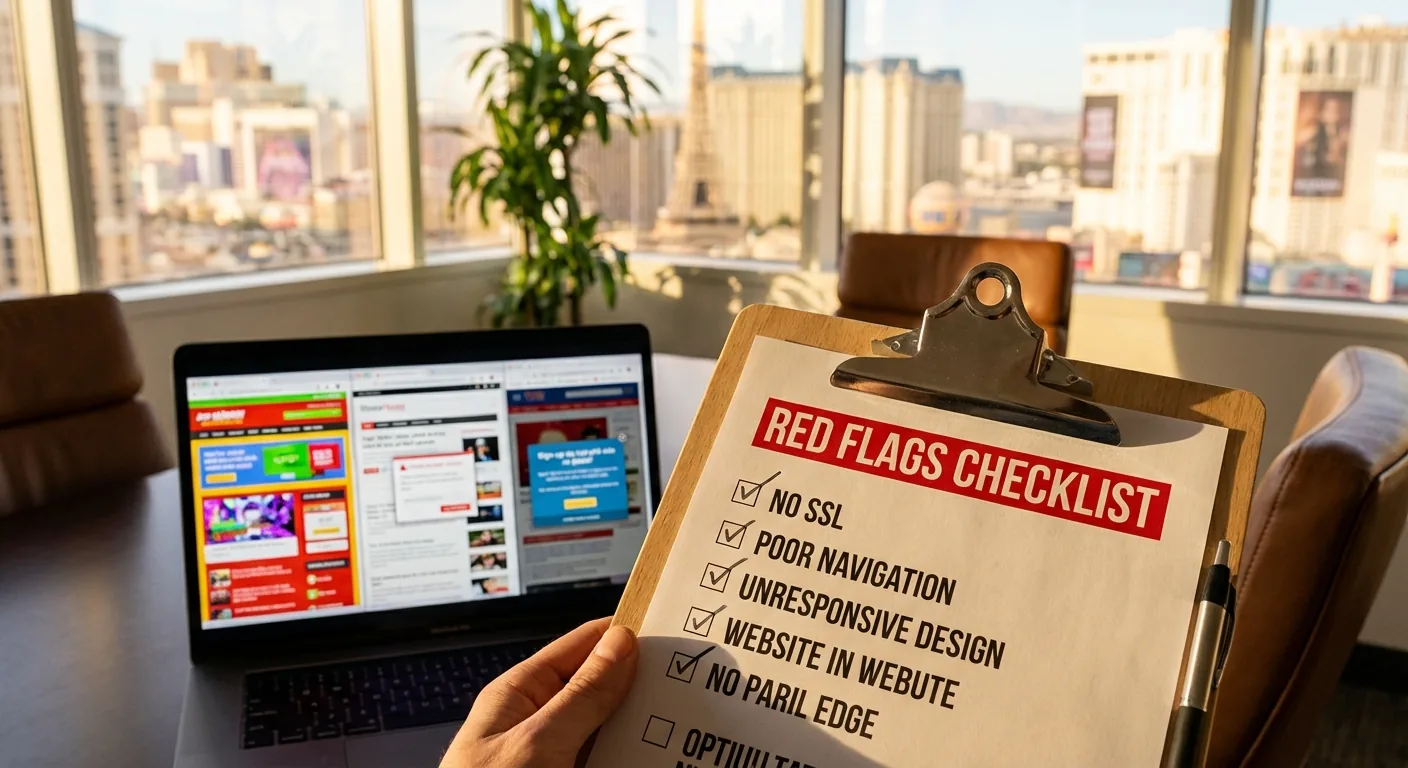
Red flags that usually lead to regret
Walk away if you see any of these:
- guaranteed ranking promises
- refusal to discuss conversion metrics
- no mention of technical SEO
- no attribution/analytics setup in scope
- all payment due upfront
- no clear post-launch support path
- pressure to sign quickly before details are documented
These patterns are common in failed projects.
Budget conversations: what "good value" actually means
Choosing the lowest bid is not savings if you rebuild in 12 months.
A good proposal should clearly map spend to business outcomes:
- what this scope will improve
- how results will be measured
- where risks and limits are
If you want pricing context, review web design cost ranges in Las Vegas before comparing bids.
Local context: what Las Vegas businesses should prioritize
For most local categories in this market, your site must support:
- fast mobile conversion for urgency queries
- trust-first messaging for high-ticket services
- service + neighborhood relevance
- clean integration with paid and local SEO channels
This is why web design and marketing strategy should not be separated completely.
A strong team understands how the site supports local SEO in Las Vegas and paid demand capture together.
Practical hiring process (2-week framework)
Day 1-3: prep
- document goals and KPIs
- define must-have pages and features
- set budget band and timeline
Day 4-8: interviews
- run the 10-question capability screen
- request sample process docs/checklists
- collect proposal drafts
Day 9-12: scoring + diligence
- score with matrix
- check references
- review contract terms with attention to ownership/support
Day 13-14: select + align
- choose best fit by value, not hype
- confirm kickoff agenda, milestones, and communication cadence
This process prevents reactive decisions.
What to do if you already got burned once
A lot of owners are in this situation.
If your last project failed:
- audit what was actually delivered vs contracted
- identify missing conversion and SEO fundamentals
- salvage what can be reused
- rewrite scope around outcomes before re-hiring
Do not start from anger. Start from clear requirements.
Due diligence calls: how to get honest answers
Ask for one reference call from a client similar to your business size.
During the call, ask:
- what was promised vs delivered?
- how did communication feel during delays?
- what happened in the first 90 days after launch?
- did lead quality improve or just traffic?
This cuts through sales positioning quickly.
How to run a paid pilot before full commitment
If trust is low, start with a paid discovery and architecture phase.
Pilot output should include:
- clear site map and conversion plan
- messaging framework for key pages
- technical requirements and launch checklist
- realistic execution timeline
Then decide whether to proceed to build.
This model reduces risk and gives you useful assets either way.
Internal ownership: who on your side should own the project
Even with a great partner, you need one internal owner.
That person should:
- approve priorities quickly
- coordinate stakeholder input
- protect scope from random additions
- own weekly status decisions
Without internal ownership, good vendors can still fail.
Decision filter for final selection
At the end, choose the team that can tie design choices to lead outcomes with specific reasoning.
That is the practical answer to how to choose web design company candidates in a crowded market. If they cannot explain "why this layout converts better for your buyer," keep looking.
Post-launch accountability questions
Before kickoff, agree on what happens after launch.
Ask:
- who monitors first 30-day performance?
- what issues are fixed inside warranty vs billed separately?
- how quickly are urgent lead-blocking bugs handled?
- who owns conversion reporting cadence?
You want a partner that plans for outcomes after launch day, not just delivery day.
Pricing negotiation without breaking quality
If budget is tight, negotiate scope sequence, not quality fundamentals.
Safer cuts:
- phase secondary pages into month two
- reduce non-essential animation
- defer lower-priority integrations
Do not cut:
- conversion architecture
- tracking setup
- technical SEO basics
- mobile performance work
That balance protects ROI while controlling spend.
Decision confidence check before signature
Before you sign, pause for one final check:
- can the team explain your user journey in plain language?
- can they show exactly how success will be measured?
- do you understand who is accountable post-launch?
If all three answers are yes, you are likely making a strong choice.
Keep your shortlist tight
Three strong proposals are enough. More options usually create noise, not clarity overall.
Should one company handle design + marketing?
Sometimes yes, sometimes no.
One partner can be efficient when:
- they have proven depth in both areas
- accountability is clear
- reporting ties site and campaigns together
Separate partners can work when:
- internal owner can coordinate both effectively
- each side has clear boundaries and communication protocol
Whichever model you pick, enforce shared KPIs and weekly visibility.
Final decision rule
Choose the team that can explain, in plain language, how your new site will:
- attract the right traffic
- convert that traffic into qualified leads
- provide measurement you can trust
If they cannot explain that, do not hire them.
Because in the end, how to choose web design company in Las Vegas is less about style and more about systems. You are hiring a revenue asset builder, not a digital decorator.

For broader planning, align the website project with your digital marketing strategy so design, SEO, and paid channels support one growth plan.
Ready to stop guessing? Book a free strategy call with VegasOps.