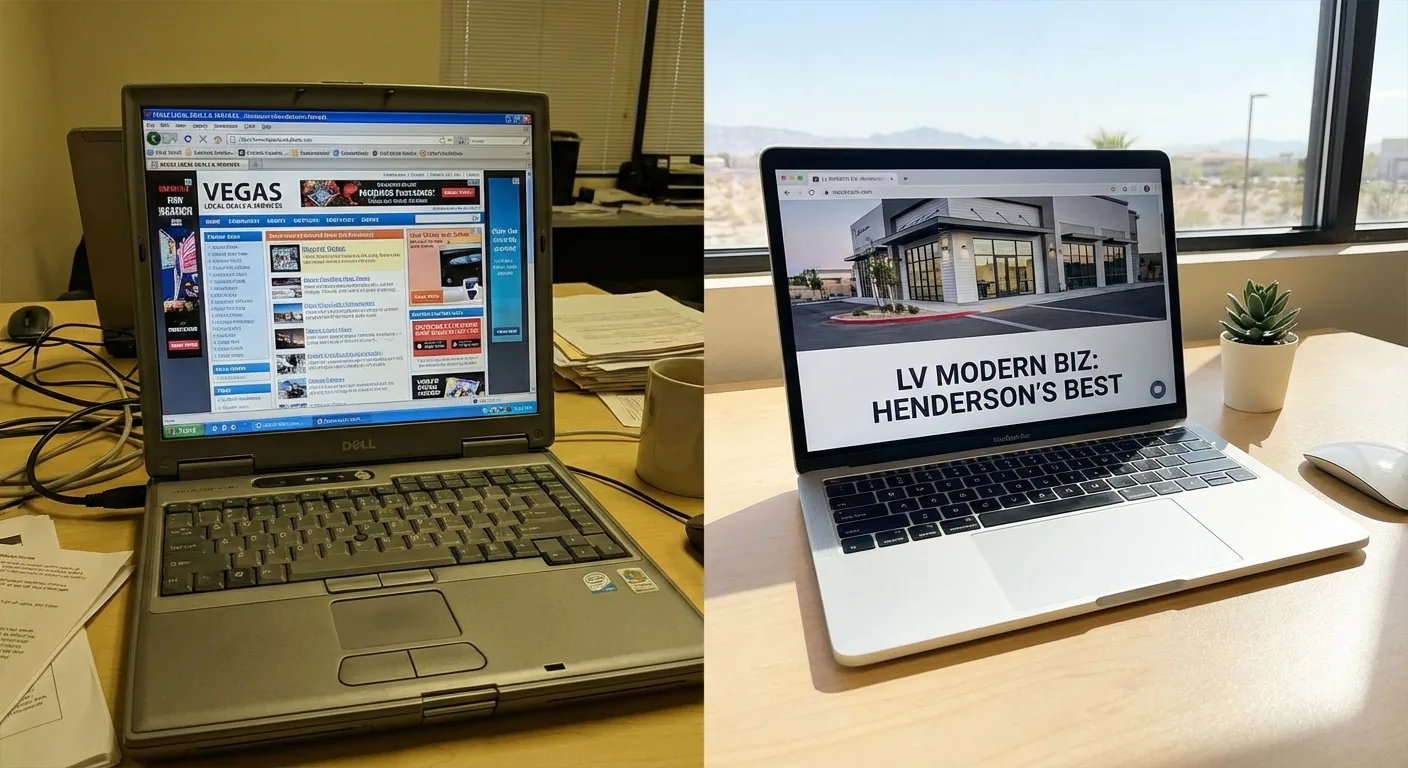
If you are searching website redesign las vegas, you are probably feeling the same frustration we hear every week: your business is solid, your team does great work, but your website still feels like dead weight. It looks dated, loads slowly, and the leads that do come in are either low quality or completely random.
Most owners wait too long to act because redesign sounds expensive, risky, and disruptive. Fair concern. But in Las Vegas and Henderson, waiting usually costs more than rebuilding. You are competing in a market where buyers compare options fast, often on mobile, and make decisions within minutes.
Let’s make this practical: how to tell if you need a redesign, what it should cost, what to avoid, and how to ensure the new site actually produces qualified leads.
Redesign vs tune-up: know the difference first
Not every site needs a full rebuild. Some need targeted conversion fixes, stronger service pages, and better tracking. Others are fundamentally broken and should be rebuilt from the foundation.
You likely need optimization-only work if:
- your CMS is stable and easy to edit
- pages load reasonably fast on mobile
- users can find services in 1-2 clicks
- call/form conversion paths are clear
- tracking is accurate and actionable
You likely need a full redesign if:
- mobile experience is clunky or hard to use
- top service pages have high bounce + low conversion
- page structure cannot support growth
- content is generic and untrustworthy
- your team avoids updating the site because it is painful
Business owners often ask, “Can we just keep patching it?” You can. But if structure is bad, every patch creates more technical debt. That is how you end up paying for three mini-projects and still launching a redesign six months later.
The biggest signs your site is costing you revenue
1) Slow mobile load on high-intent pages
When someone in Henderson searches for “emergency HVAC repair” at 8:30 PM, they are not patient. If your page stutters for five seconds, they hit back and call the next result.
In local service categories, slow mobile speed is not a brand problem. It is direct revenue leakage. Run Core Web Vitals on your top pages, not just your homepage.
2) No clear offer and no clear next step
Owners often think the site “looks professional,” but users still do not convert because the message is vague:
- what exactly do you do?
- who do you serve?
- why should they trust you?
- what should they do now?
If those answers are not obvious in the first screen, conversion drops hard.
3) Service architecture is confusing
A common issue in older sites: one broad “Services” page trying to rank for everything. In Las Vegas, that kills relevance. You need focused pages by service intent and location intent, then smart internal linking.
4) Trust proof is weak or outdated
No recent reviews. No local case context. No proof of process. No clarity on response time. Buyers assume risk when trust proof is missing.
5) You cannot measure what is working
If your current setup cannot tell you:
- which pages drive qualified calls
- which channels bring high-quality leads
- where users drop before converting
then you are running blind.

What a smart website redesign las vegas project includes
A real redesign is not “pick a template and rewrite headlines.” It is a business system rebuild focused on demand capture and conversion.
Minimum scope should include:
- discovery tied to revenue goals (not aesthetics alone)
- service + location page architecture
- copy strategy aligned to buyer objections
- mobile-first UX and interaction simplification
- technical SEO foundation (indexing, schema, internal links)
- conversion tracking for calls/forms/key actions
- launch QA + post-launch iteration plan
If an agency cannot explain their architecture and post-launch plan, you are probably buying a visual refresh, not a growth asset.
Real cost ranges in Las Vegas and Henderson
Pricing varies, but these ranges are useful planning anchors.
Conversion refresh: $4,000-$10,000
Best for businesses with usable structure but weak messaging and UX. Includes key-page rewrites, performance fixes, trust blocks, and conversion path cleanup.
Strategic rebuild: $10,000-$25,000
Most common for established local businesses. Includes full page architecture, copy overhaul, technical cleanup, and structured content migration.
Advanced multi-service rebuild: $25,000+
For high-competition categories or multi-location operations with complex service lines, deeper SEO architecture, and full tracking/automation integration.
If someone quotes a very low fixed price with a vague scope, ask what is excluded. Often it is content depth, tracking, technical SEO, and post-launch support, which are the exact pieces that create results.
What drives redesign cost up or down
Main cost drivers:
- number of pages requiring net-new copy
- complexity of service/location architecture
- migration from old CMS or messy template stack
- design system depth and component count
- technical cleanup requirements
- approval process and stakeholder count
Cost goes down when scope is focused and decisions are fast. Cost explodes when teams keep changing direction without a defined brief.
How to avoid wasting money on a redesign that still fails
This is the part most owners care about. Here is the no-BS checklist.
- Tie project goals to measurable outcomes before design starts.
- Prioritize top revenue pages first, not low-impact pages.
- Demand copy strategy, not placeholder lorem structure.
- Review wireframes for conversion logic, not just appearance.
- Require analytics + call tracking before launch.
- Require a 60-day post-launch optimization sprint.
If you skip these, you might get a beautiful site that still does not move leads.
Las Vegas/Henderson context that should shape the build
Your local market has specific behavior patterns:
- heavy mobile research and fast vendor comparison
- neighborhood-level intent (Summerlin vs Henderson vs North Las Vegas)
- high urgency in trades/medical/legal categories
- sensitivity to trust, speed, and response quality
Your redesigned site should speak like a local operator, not a generic agency template.
That means:
- location-aware proof points
- clear service-area language
- response-time expectations
- direct next-step CTAs
Content structure that usually wins for local service businesses
Every high-performing redesign we see includes:
- clear homepage promise + routing to core services
- one page per high-intent service
- neighborhood/location support pages where relevant
- conversion-focused trust content (FAQs, process, proof)
- internal link system that reinforces intent pathways
This is also why strong redesigns connect with Las Vegas SEO services and web design strategy from day one. SEO and conversion are not separate projects.
What to expect after launch
Good launch outcomes usually happen in phases:
- week 1-2: better form/call conversion behavior
- week 3-6: clearer signal on lead quality by page
- month 2-4: better organic engagement on rebuilt pages
- month 4-6: compounding gains when content + SEO execution continues
A launch is not the finish line. It is the start of a better iteration cycle.
Should you redesign now or wait?
Use this fast rule:
- redesign now if lost leads are already obvious and structural issues are clear
- wait only if your current site is structurally sound and you lack traffic
If demand exists but conversion is weak, delay is expensive.

Pre-redesign checklist: do this before signing any proposal
Before committing budget, collect baseline data so you can judge success objectively.
Capture:
- current conversion rate on top 5 revenue pages
- qualified calls/forms per month
- mobile speed metrics for key pages
- top traffic channels and lead quality by channel
- current keyword visibility for service + location terms
Then define redesign success targets:
- conversion rate lift goal
- qualified lead growth target
- mobile speed target
- response and booking performance target
Without baseline numbers, teams can claim progress with vanity metrics while pipeline quality stays flat.
Post-launch cadence that protects ROI
Week 1:
- tracking and form/call QA
- CTA click validation
- mobile UX walkthrough on real devices
Week 2-4:
- session behavior review
- trust and objection-copy refinements
- fast improvements to top pages
Month 2+:
- channel-level conversion review
- index/ranking health checks
- lead-quality feedback from sales/front desk
This is where a redesign becomes a growth asset, especially when tied to local SEO execution and paid landing page optimization.
Questions to ask before you approve final designs
Use these in your design review meeting:
- Can a new visitor understand our primary service in 5 seconds?
- Is the main CTA visible without scrolling on mobile?
- Do top pages show recent local proof?
- Are objection-handling sections clear and specific?
- Is there a fast path for urgent leads?
If your team cannot answer “yes” quickly, do not launch yet.
Final take
Choosing website redesign las vegas is not about chasing a trend. It is about deciding whether your website is an asset or a liability.
A smart redesign clarifies your offer, improves trust, shortens decision time, and captures more qualified demand from Las Vegas and Henderson. A bad redesign burns budget and gives you a prettier version of the same problem.
If you are unsure which side you are on, start with a scoped audit, not a full commitment. Review conversion leaks, technical risks, and content gaps, then decide with data.
Ready to stop guessing? Book a free strategy call with VegasOps.