VegasOps
Back to Blog
March 5, 2026
8 min read

Why Your Las Vegas Website Is Not Getting Leads (And How to Fix It)

If your Las Vegas website looks great but generates zero leads, here is why — and the exact fixes that turn it into a lead machine.

If your website not getting leads situation feels maddening, you are not crazy. This is one of the most common problems for Las Vegas businesses: the site looks modern, traffic exists, but inquiries stay flat.

The issue is almost never one single bug. It is usually a stack of small conversion leaks that compound.

Let’s break down the real causes and practical fixes.

Las Vegas business website not getting leads

Symptom check: traffic is not the same as demand

First, separate these two realities:

  • You can have website sessions without buyer intent.
  • You can have buyer intent and still lose leads due to poor conversion flow.

Most owners only look at sessions and bounce rate. That is not enough.

You need to inspect:

  • landing page source mix
  • query intent quality
  • conversion action rates by page
  • call answer rates and follow-up speed

Without this, you will optimize blindly.

Cause 1: wrong traffic intent

A lot of sites rank or run ads for broad terms that look good in tools and produce weak leads.

Example:

  • Broad "digital marketing" traffic from outside Nevada
  • informational searches with no purchase intent
  • mismatched ad targeting pulling low-fit users

Fix:

  • focus content and campaigns on service + location intent
  • tighten geographic targeting
  • use negative keywords aggressively
  • build landing pages that match exact query intent

If your audience is local, your targeting should act local.

Cause 2: weak above-the-fold message

Visitors decide quickly if they should stay.

Common failure:

  • headline talks about company, not customer problem
  • no clear value proposition
  • generic CTA like "Learn More"

Fix:

  • state who you help and what outcome you deliver in one clear sentence
  • use a concrete CTA tied to buyer stage
  • place phone + form action visibly on mobile

For many sites, this alone lifts conversion rate.

Cause 3: too many choices, no clear path

When every page has six competing CTAs, users stall.

Symptoms:

  • cluttered nav
  • multiple equal-priority buttons
  • no obvious next step

Fix:

  • assign one primary CTA per page
  • keep secondary actions minimal
  • align page objective with traffic source intent

Clarity beats creativity in conversion.

Cause 4: low trust signals

In local services, trust is a conversion currency.

Missing trust elements:

  • real reviews near CTA
  • local proof (projects, neighborhoods served)
  • certifications/licenses
  • team photos and real contact info

Fix:

  • add proof blocks near forms and call buttons
  • show specific outcomes where possible
  • include local references that buyers recognize

A credible page converts better even with the same traffic.

Cause 5: mobile UX is quietly killing leads

Most local intent traffic is mobile. If mobile is slow or clumsy, lead rate collapses.

Mobile problems that hurt:

  • slow Largest Contentful Paint
  • hard-to-tap buttons
  • form fields too long
  • sticky chat widgets blocking CTA

Fix:

  • improve load speed first
  • simplify forms to essentials
  • add click-to-call sticky button
  • test full journey on actual phones, not desktop preview

Do this before spending another dollar on traffic.

Cause 6: form friction and bad follow-up

Some sites ask for too much up front:

  • full address
  • project scope essay
  • multiple required dropdowns

This reduces completions.

Fix:

  • short initial form (name, contact, service need)
  • collect detail during follow-up call
  • trigger immediate confirmation and response workflow

And yes, response speed matters. In competitive categories, first serious response often wins.
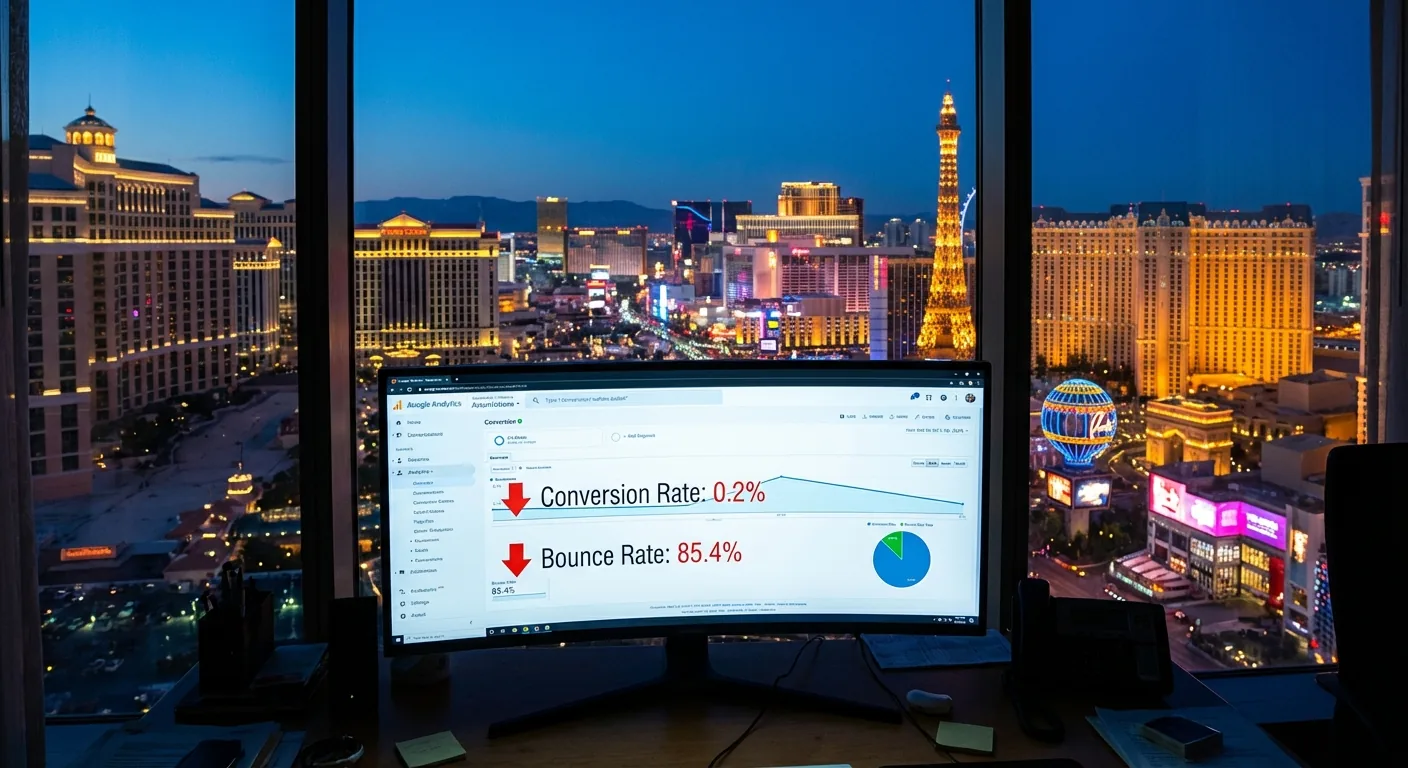
Website conversion analytics dashboard Las Vegas

Cause 7: no offer, just "contact us"

Generic contact prompts underperform.

High-converting alternatives:

  • "Get a same-day estimate"
  • "Request a 15-minute strategy review"
  • "See pricing range for your service"

Offer should match user intent stage. People need a reason to act now.

Cause 8: poor local relevance on core pages

If you serve Las Vegas and Henderson but your site reads like a generic national template, local conversion suffers.

Fix with:

  • service + city references where natural
  • neighborhood-specific proof where relevant
  • internal links to location-supporting content

Use links intentionally, for example to local SEO strategy or Las Vegas digital marketing services.

Cause 9: tracking is broken or incomplete

Many businesses cannot answer "which page produced this lead?"

If tracking is weak, optimization guesses dominate.

Minimum setup:

  • GA4 event tracking for key actions
  • call tracking numbers by source where possible
  • CRM field for lead source and quality
  • dashboard showing qualified leads by channel/page

Once this is in place, decisions get easier quickly.

Cause 10: no testing cadence

Websites are rarely "done." Markets shift. Competitors adapt. User behavior changes.

If you launch and stop iterating, performance drifts down.

Set a monthly test cadence:

  • headline variant tests
  • CTA copy tests
  • form length tests
  • trust block placement tests
  • offer framing tests

Small wins compound.

30-day rescue plan for a low-converting site

Week 1: diagnosis

  • audit top 5 landing pages
  • inspect traffic intent by source/query
  • verify analytics and call tracking
  • identify top three conversion leaks

Week 2: fast fixes

  • rewrite above-the-fold messaging
  • simplify forms
  • add trust proof near CTA
  • improve mobile CTA visibility

Week 3: alignment

  • match ad groups to exact landing pages
  • refine local relevance on core service pages
  • remove weak or distracting page elements

Week 4: measurement + iteration

  • compare before/after conversion rates
  • evaluate lead quality changes with sales team
  • plan next test cycle on highest-impact pages

Most businesses see measurable lift if execution is disciplined.

Lead-quality audit template you can run today

Open your last 30 days of leads and categorize each as:

  • qualified and booked
  • qualified but lost
  • unqualified
  • duplicate/spam

Then map each lead back to source and landing page.

This instantly reveals where your website not getting leads issue is actually a qualification issue, messaging issue, or targeting issue.

Copy framework for higher-converting service pages

Use this simple structure:

  1. Problem-aware headline with local relevance
  2. Clear promise and timeline expectation
  3. Proof block (reviews/certs/results)
  4. What happens next section
  5. Low-friction CTA

Most underperforming pages are missing two or more of these blocks.

Call handling and missed lead recovery

For local service categories, a missed call process is mandatory.

Set up:

  • immediate missed-call text response
  • callback queue with priority order
  • after-hours intake workflow

A surprising share of "website not getting leads" complaints are really "we did not recover inbound opportunities fast enough."

Quarterly optimization rhythm

To keep gains, run this quarterly:

  • refresh top page copy with real call insights
  • update trust proofs and recent local work
  • refine offers based on close-rate data
  • retest mobile flow end to end

This keeps conversion performance from decaying over time.

Lead response SLA that protects conversion rate

If you want a fast boost, enforce a response standard:

  • answer or return calls within 5 minutes when possible
  • respond to form submissions inside 10 minutes during business hours
  • use after-hours auto-response with next-step timing

Even strong pages lose money when follow-up is slow.

For many operators, the website not getting leads complaint improves once response operations are fixed alongside page changes.

One-page weekly scorecard

Keep one simple weekly scorecard:

  • qualified leads
  • close rate
  • response speed
  • top converting page
  • top leaking page

This keeps your conversion fixes focused on measurable outcomes.

How to prioritize fixes by impact

Use this simple filter for each issue:

  1. how many users are affected?
  2. how close are they to purchase intent?
  3. how fast can we implement the fix?

Prioritize high-traffic, high-intent, fast-fix issues first.

Do not spend two weeks redesigning low-traffic blog pages while your top service page leaks leads.

Las Vegas-specific conversion considerations

In this market, buyers often compare multiple providers fast.

To compete:

  • be explicit about response time
  • make contact friction low
  • show local proof and recent activity
  • support both call and form paths

If your business gets after-hours demand, capture process matters even more. Missed calls are lost revenue.

When you should redesign vs optimize

Optimize first when:

  • architecture is usable
  • major issue is messaging/CTA/trust
  • technical performance can be improved without rebuild

Redesign when:

  • site structure blocks expansion
  • performance is severely outdated
  • CMS/workflow makes iteration impossible

Many businesses can recover lead flow without full rebuild if they fix fundamentals.

What good performance looks like

Exact conversion rates vary by industry, but healthy patterns include:

  • clear lead growth on core pages
  • stable qualified lead quality
  • lower wasted spend on weak traffic
  • faster sales follow-up loop

If metrics improve but quality drops, keep refining intent targeting and offer fit.

Website redesign before and after Las Vegas

Final take

When your website not getting leads problem persists, the answer is usually not "buy more traffic." The answer is intent alignment, conversion clarity, trust proof, mobile usability, and relentless iteration.

Fix the highest-impact leaks first. Track qualified outcomes honestly. Build a monthly testing rhythm. That is how a pretty site becomes a lead-producing asset.

If you are stuck, connect your website fixes to a broader digital marketing playbook for Las Vegas so traffic, SEO, and conversion all move together.

Ready to stop guessing? Book a free strategy call with VegasOps.

Want us to take a look?